
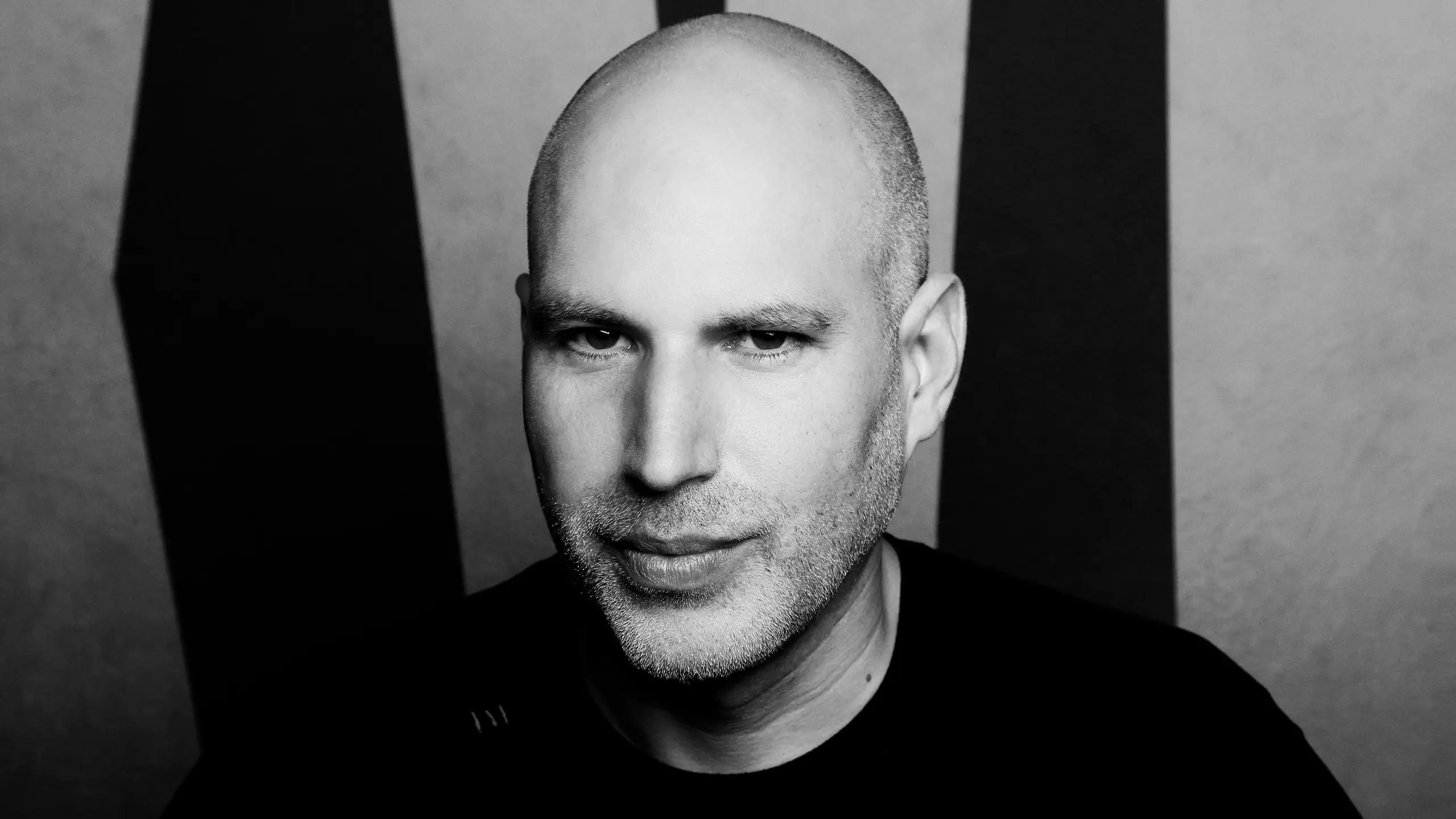

Daniel Bell is a name you don’t need to Google if you’ve ever seriously stepped onto a techno dancefloor. A pioneer who pushed the boundaries of minimal sound back in the early ’90s, releasing under the alias DBX, Bell left an indelible mark with the track “Losing Control”—still considered a textbook example of how to craft a hypnotic groove out of almost nothing.
Born in California, raised in Canada, and musically shaped in Detroit, Bell was part of the foundational techno generation alongside names like Richie Hawtin, with whom he launched the Cybersonik project. His label, Accelerate, remains one of the cornerstones of the minimal techno aesthetic.
Just ahead of his set at Belgrade’s Karmakoma on Saturday, March 29, we sat down with him for a quick chat for The Clubber—about the current state of the scene, marathon DJ sets that stretch 10 hours long, and what it means to stay relevant without having to raise your voice.
New music cycles in and out faster than ever — have you heard anything recently that felt like a true hit, something with the spark to last? On the other hand, how does club music from a few decades ago stand the test of time from your perspective in the booth?
There’s been an interesting shift in dance music over the years. While there’s more accessibility now—which has meaningfully democratized production and DJing—I find myself searching more for tracks that leave a lasting impression.
We’re surrounded by more music than ever before, and that’s made thoughtful curation increasingly important—something I see as essential, both as a DJ and in my own production work.
Your arrangements often feel like a stripped-down, raw coloring book that only gets its full palette halfway into the track. More often than not, that proves to be a recipe for longevity in dance music. But how do you stop yourself from overdoing things, especially with all the gear and new toys available today?
I think there’s something timeless about creating space in music—letting tracks breathe and evolve naturally rather than filling every moment. That approach is deeply rooted in club music history, from early days in New York and Chicago to scenes around the world.
For me, it’s about respecting that tradition while still making it my own. Even with all the amazing technology we have today, I’m still drawn to the fundamental rhythm and repetition that gets people moving. There’s something magical about building anticipation and letting moments slowly unfold on the dancefloor.
Having creative constraints can be a good thing. When I’m in the studio, the question is usually, “Does this element serve the groove?”—instead of just adding things because I can. That kind of discipline helps keep the focus on what really matters.
What kind of settings have you most enjoyed playing in recently?
For the past 15 years or so, I’ve been focusing on much longer sets. I think the sweet spot is around 7 hours, but sometimes it extends to 10 or even 12. That format gives me the freedom to build a mood and really experiment. Of course, not every venue allows for that kind of exploration, but those longer sets definitely help shape the way I approach shorter ones, too.
What can we expect on Saturday? If you had to invite the crowd with just one song, what would it be?
A: First off, I’m really looking forward to being back in Belgrade! I usually don’t come into a venue with a fixed plan. The goal is to respond to the energy in the room and what’s connecting with the crowd. That kind of spontaneity tends to create much more interesting sets than sticking to something pre-programmed.


You must be logged in to post a comment.